Tertius Bonnin · 25 November 2026

Why recent headlines don’t change the bigger picture
If you’ve been following the news this month, you may be feeling uneasy. Global shares have fallen from their October high, led by technology companies. Nvidia, the world’s most valuable chipmaker, has found itself at the centre of the sell-off in an unusual controversy. And the US midterms gave Democrats control of both houses of Congress, with voters’ concerns about AI and data centres playing a part.
It’s natural to feel unsettled by news like this, but headlines rarely tell the whole story. Beneath them, the US economy is growing, company earnings are strong, and spending on AI is having a meaningful impact on growth rates. Below, we explain what’s happened, why we think the long-term picture still holds, and what, if anything, we’re changing in your portfolio.
Why investors are cautious about AI
In the last few months, there has been intense focus on whether the spending on AI infrastructure will ultimately deliver financial returns. For context, capital expenditure forecasts for AI spending in 2026 are approaching $1 trillion, eclipsing the scale of previous capital expenditure projects in historic market cycles. What is concerning for investors is that many of the companies involved in the data centre buildout, such as Microsoft, Meta and Alphabet, are starting to rely more heavily on issuing debt to fund their expansion plans. If the expected financial returns from AI don’t materialise, markets are at risk of disappointment spilling over into share prices.
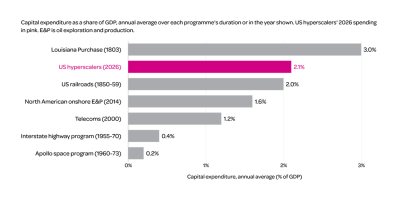
Source: Companies World Bank, Wall Street Journal, S&P Global, Polar Cap Technology Investment Trust reports and accounts (2026).
More recently, an unusual development at one of the world’s largest businesses, chip designer Nvidia, has unnerved both markets and the US political establishment. While Nvidia, a prime beneficiary of the AI trade, was already at risk of weakening sentiment towards, the headlines about the CEO’s involvement with an alleged Chinese spy and his subsequent resignation compounded the pessimistic mood in the market. Even the exceptionally strong earnings results on 17 November failed to reverse the negative trend. In an extraordinary turn of events, however, the announcement by the Board of Jensen Huang’s reinstatement as CEO sparked an exceptional market rally which saw almost $1 trillion of value added to Nvidia’s market capitalisation. Clearly this is an evolving story and one we are monitoring closely given the importance of the company to broader market sentiment.
Anthropic’s blockbuster Initial Public Offering (IPO)
The IPO of Anthropic, the maker of AI tool Claude, was a crucial milestone for the AI theme in that one of the two leading closed-source AI research labs is now a public company. Anthropic set a record with its impressive $107 billion raise, smashing SpaceX’s $75 billion raise earlier in the year, becoming the largest IPO in history. It also highlights the dynamism, and flexibility capital markets still have towards what they consider to be genuine growth stories.
Anthropic is only the latest AI-related company to raise capital on public equity markets this year following Alphabet, Meta and SpaceX. These four companies together have raised almost $300 billion in new equity which will surely only add to questions about whether AI-spending can generate a sufficient return on investment.
Despite the hesitation, spending on AI infrastructure and adoption of AI tools has been ramping up. Nvidia’s data centre revenue has increased 110% over the last year alone and Anthropic’s revenue is growing significantly. The question we face as investors is who captures the value. Data centres built today will take years to reach full capacity, and the gains may end up with the users of AI tools rather than the companies spending enormous sums to build it.
AI has become a kitchen-table issue for American voters
The polling data suggests most voters considered AI and data centres important to their choice, driven largely by electricity bills, environmental damage, local land use and job concerns. Scepticism runs from Republicans and Democrats. Having been a major topic for debate during the November 2026 US midterm elections, debate will likely feature in the 2028 presidential primaries ahead of the next presidential election. Its outcome may be the single most important AI policy variable for 2029 and beyond as the next president begins to make their mark on US policy.
The AI sector is already adapting, with OpenAI pledging to pay the full electricity and infrastructure costs of its sites. We expect commitments like this and more community involvement in the planning stage to become the social cost of building AI data centres. This could mean higher spending requirements and thinner profit margins but will result in a buildout that is more politically durable with buy-in from the public. Moreover, restricting the supply of new compute capacity can make existing capacity scarcer and more valuable, which can widen the competitive advantages of companies already operating large-scale AI data centres while raising the costs for developers stuck in the permitting stage.
What this means for portfolios
We are continuing to look closely at the financial health of companies across the AI supply chain and are drawing a clear line between companies that already run data centres and those still waiting for permits or relying on borrowed money to build them. Some businesses could benefit. If new rules require developers to pay for their own infrastructure and involve local communities more, companies that help cut power and water costs could see demand grow.
We are watching three things in particular: how US lawmakers respond now the final Senate results are in, whether AI spending levels persist, and the direction of interest rates and inflation.
As ever, diversification across asset classes, sectors and regions remains our first line of defence against both political surprises and volatility in high growth sectors such as AI.