Electricity demand is growing again in developed countries after decades of stagnation, driven by shifts in consumer behaviour – like increased use of electric vehicles and changing heating and cooling needs. This aligns with efforts to decarbonise by moving away from fossil fuels to low-carbon electricity sources.
A major new driver of demand is the rapid expansion of AI infrastructure, particularly the energy-intensive data centres it requires. These can strain local power grids and raise concerns about their carbon footprints, depending on how clean the local energy mix is
Rising emissions conflict with the climate commitments made by major technology companies to reduce greenhouse gases. This has driven a targeted increase in demand for low-carbon energy sources such as wind, solar, and nuclear. Highlighting the scale of expected electricity growth, the International Energy Agency (IEA) – a leading intergovernmental body offering energy policy guidance – has released a report specifically addressing AI’s impact on electricity demand.
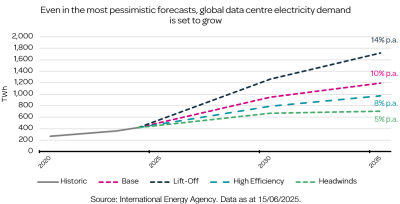
The International Energy Agency’s base case projects that global electricity demand from data centres will double by 2035. It also outlines three alternative scenarios: a “lift-off” scenario with rapid AI growth, a “high efficiency” scenario with major improvements in energy use, and a “headwinds” scenario with slower AI adoption.
Even under the most conservative outlook, electricity demand is expected to rise – underscoring the urgent need for greater efficiency. As AI infrastructure expands, efficiency will emerge as a key priority alongside resilience and reliability. Given AI’s high energy intensity, improving efficiency is not only vital for sustainability but also essential for economic viability.
To boost profitability, data centre operators must focus on reducing ongoing electricity consumption without compromising operations.
Beyond individual centres, major growth opportunities lie in energy efficiency, grid management, transmission and distribution, and electric utilities.
It is at this critical intersection – where technological demand meets energy innovation – that the case for sustainable investment is most compelling.